.png)
Why Leaders Feel Like They Need to Be in Every Meeting (and How the AAA Time Framework Fixes It)

Meetings are everybody's biggest frustration, and yet most leaders keep showing up to them without ever asking why.
Are you invited because you need to be in the room,
or
Are you invited because you always go?
If you've ever wondered why leaders feel like they need to be in every meeting, even ones where they have no active role, no actions to own, no updates to give, this is about why that happens and what to do instead.
Why Leaders Feel Like They Need to Be in Every Meeting
The first issue is straightforward: leaders aren't being conscious enough about the decisions they make around attending meetings. If you can't see a reason you need to be in the room, whether as a decision-maker or a subject matter expert, it's fine to push back. That doesn't have to be a flat 'no'; it can be a simple email or quick call asking what your role actually is in that meeting.
The second issue is FOMO (Fear of Missing Out). A lot of leaders attend meetings because they're worried that if they're not in the room, things won't happen, or won't happen the way they want.
That's a belief problem, and that is for you to work on and resolve. The question worth asking yourself is what's in your belief system that tells you that you need to be there. What are you actually worried about? What's the fear you need to let go of?
If your main complaint is that your diary is too full to get anything done, but you're saying yes to every meeting you're invited to, that's the contradiction to challenge. It doesn't matter who invites you to what; you're the person saying 'yes' to being there.
That is within your gift to change.
What Leaders Are Actually Telling Themselves About Meetings
Leaders commonly say they're worried that if they're not in the meeting, things won't get sorted properly. That because they were invited, especially by someone more senior, they should turn up. That if they skip it and it goes wrong, they'll feel responsible.
Senior Leader, Higher Education:
"I'd forgotten that at the position I'm in, it's my decision whether I go or not. You very quickly fall into the idea that I've been invited, that looks important, I don't want to miss out. And actually recognising that I've got terrible FOMO, I am my own worst enemy for going to things."
That fear of missing out, or of not being involved, or of looking like you're not taking responsibility, is what shapes leaders into saying yes to everything.
It's scary to let go or say no.
You're not alone if that's you.
What Meeting Time is Actually Costing Leaders
The real challenge is what happens once you're in the room. Leaders end up sitting in meetings where everybody is saying the same thing, everybody's in agreement, lots of people saying yes, but nobody taking ownership of the actions.
Often the right people aren't in the room, or there are too many of the same people, offering the same perspective in it, and so some people contribute nothing at all.
It's the commonly shared meme that's true more often than not:
'How many of those meetings could genuinely have been an email'?
It isn't just a joke, though. A 2022 MIT Sloan Management Review study of 76 large companies found that introducing meeting-free days, enough to cut overall meeting time by around 40%, was linked to real shifts: higher autonomy, less micromanagement, lower stress, and a rise in productivity.
This is evidence that fewer meetings isn't a nice-to-have, it changes how a team actually operates.
There's a second cost that gets missed just as often: no protected time around meetings.
Senior Leader, Public Sector:
"Those half-hour meetings in the day, that chopping and changing, not having any protected time after meetings and just going straight into other ones. Still thinking about the actions from that one, so not being fully present."
Without space before a meeting to prepare and get into the right headspace, or space after to action what you've picked up, you're not going to be effective in that meeting. You're mentally not ready, and you're probably still thinking about the meeting you were in ten minutes ago. It doesn't help anybody, and it definitely doesn't help you.
How Leaders Can Decide Which Meetings Actually Need Them
This is where my AAA Time Framework comes in, a simple way to audit which rooms you actually need to be in.
Ascend tasks drive momentum; they move things forward. These are the meetings to prioritise.
Anchor tasks keep that momentum going: updates, actions you own, the maintenance work of leadership.
Avoid is the category that costs you time and energy without moving anything forward. It's a distraction, and it changes the flow of your day when you've got Ascend and Anchor work waiting.
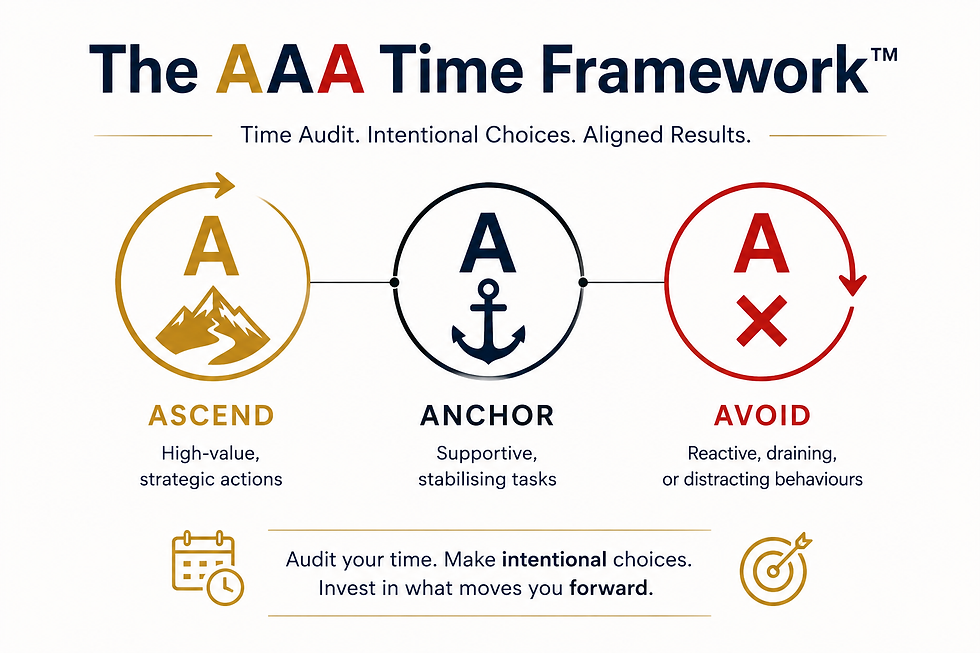
Before you accept the next invite, ask the honest question: does it really need to be you?
Our ego likes to think we're needed, that we're the person with all the answers, the one who makes the best decision to move things forward.
It's not always the case.
You probably have capable people on your team who could be there instead, or who could read the agenda and submit an update by email for the chair to read out in your absence.
Agreeing to be in every room isn't a good indication of leadership, especially if you're sitting there saying nothing, because everybody's already said it, not owning actions, or contributing to any decisions.
Not only is that a seat taken up, but it's time you won't get back.
There's also a development angle worth considering. If someone on your team is the subject matter expert, put them in the room instead. Give them the parameters, the outcomes, the updates to deliver on your behalf. That's an opportunity for them to build the skills and experience that come from being in rooms at that level, and it doesn't always need to be you. Take a step back and consider where this might be a development opportunity as part of your teams succession planning.
How to Reduce the Meetings in Your Calendar
Go through your calendar for the next two or three weeks. Look at the meetings you're in, the ones you've said yes to, and ask yourself:
Why do you need to be in the room?
Does it need your role, seniority or expertise?
If the answer is no, think about who else could be there. People will keep inviting you because they're relying on you to decide whether or not you need to be there.
That decision is yours to make, a conscious decision, not a default yes to every invite that lands in your inbox.
The same principle from my AAA Time Framework applies here: the majority of your time and energy needs to go on Ascend and Anchor activities, meetings included. Unless it's driving momentum or moving something forward, ask whether you're really the best person to be in that room.
Check your calendar. Ask yourself the question. See if you can get a little bit of time back for the work you're actually responsible and accountable for.
Be intentional about which rooms you are sitting in and giving your attention to.
Ready to be a Better Leader with Better Balance?
I'm Zoë Thompson, leadership and performance specialist, and I help overwhelmed leaders transform from reactive to intentional leadership, so you finish work on time, take The Big Week Off with zero work, zero stress and zero guilt, and create success that feels as good as it looks. - Do less, better.
The Leadership Community - A community built around learning, implementation, and support, so you can lead intentionally without losing yourself in the process.
Free Resources: www.zoethompson.uk/resources
YouTube Channel: Intentional Leadership with Zoë Thompson
Podcast: The Lightbulb: Weekly Insights for Intentional Leaders
Zoë
Good leaders can take a week off. Can you?


