.png)
Stop Glorifying Long Hours! The Best Leaders Go Home on Time.

Updated: Apr 27
Saying yes to work means saying no to something that matters!
I know that's a bold statement. But I see this pattern constantly with the leaders I work with. They're exhausted, overwhelmed, and convinced that working longer hours proves their worth as a leader.
It doesn't.
The leaders who go home on time aren't less committed. They're more effective.
They've built teams that don't need them to be constantly available. They've created systems that work without them in the room. They've set boundaries that protect both their strategic focus and their wellbeing.
And here's what makes them the best leaders: they model the behaviour they want from their teams. They lead by example, adopting the habits and behaviours that make them more efficient and more effective, and when their team mirrors this, the results are powerful.

The Hidden Cost of Saying Yes to Working Long Hours
What most leaders don't consider is that if you are logging on and working in the evenings, you are saying yes to work and therefore by default you are saying no to something else.
And if you're saying no to something else, there is a strong possibility that you are saying no to something really important to you.
Maybe it's time with your family. Maybe it's the gym session that keeps you energised. Maybe it's the hobby that helps you switch off. Maybe it's just the space to rest and recharge.
Success should feel as good as it looks. It shouldn't be all sacrifices and compromises. it shouldn't be giving up or missing out on the things that are important to us.
It also shouldn't be running ourselves into the ground - even when we love the work that we do, we still need a clear stopping point, otherwise we just run head-first into burnout.
If my strong woman days taught me anything, it is that the deload week prior to competition day is strategic, it is a big part of the high-level performance on competition day, and it is the same with our work. When we rest and recover, when we take downtime and do the things that we enjoy, the things that energise us, we slow down to speed up.
This is why rest and boundaries aren't nice-to-haves. They're fundamental.
Rest Isn't a Reward for Performance
One of the biggest myths I challenge with clients is this: rest is something you earn after you've performed.
The truth is the opposite.
Rest isn't a reward for performance. Rest is fundamental FOR performance.
Strategic thinking requires recovery. A slower pace for that part of our brain to take over and function.
Decision-making requires mental space. Leading effectively requires energy. If you're running on empty, you're not performing at your best. You're simply surviving and therefore performing at your limit.
We know from a performance level that the more we incorporate rest and recovery into routines, the higher the performance. t's not just a physical element. It's the mental element as well.
The leaders I work with who achieve 'The Big Week Off' - a full week away with zero work, zero stress, zero guilt - aren't superhuman. They've just recognised that protecting rest isn't a weakness. It's what makes sustainable high performance possible.
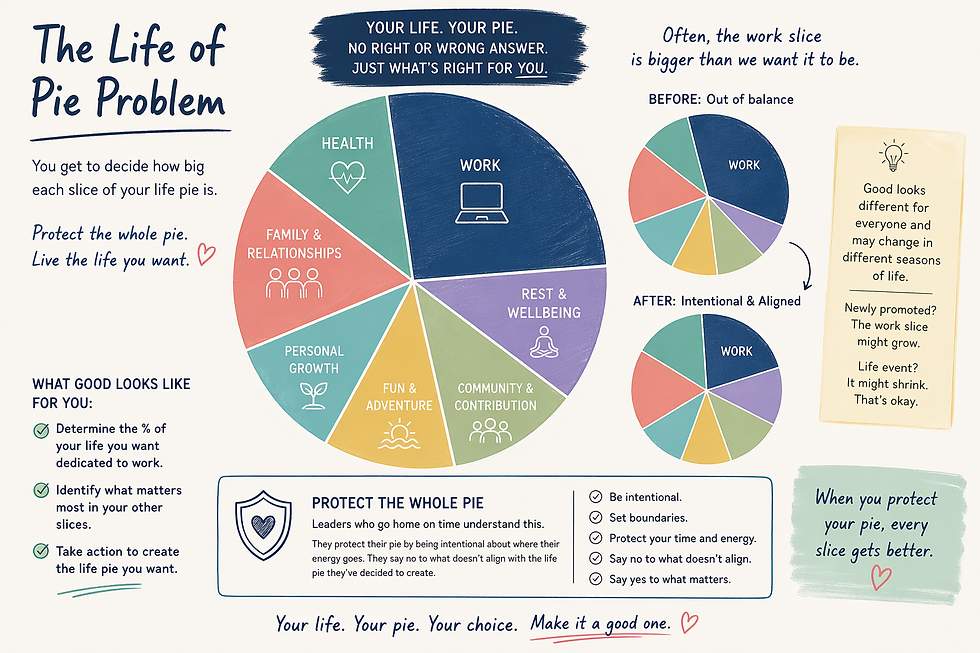
The Life of Pie Problem
I talk about this with clients often. When we picture our life, and all that is in it, we can draw it out into a pie chart. Each area of life is depicted as a slice of pie.
Naturally, we want to protect and increase some slices more than others - and that will be a very personal choice.
Often, when I first work with clients, the slice of work pie is bigger than they want it to be. We explore what good looks like and then determine what steps need to be taken to reduce the work slice - and also focus on where they want that time and energy to go within the remaining slices.
Each of us has our own idea of what good looks like in terms of how big the slice of 'work pie' There is no right or wrong answer for this; it really is personal preference and may change in different periods of time. Newly promoted may make it bigger, something happening outside of work that takes priority might make it smaller.
Leaders who go home on time understand this.
They protect the whole pie by being intentional about where their energy goes. They determine the % of their life that is dedicated to work and then protect the other slices by saying no to what doesn't align with how they want the pie, and all its slices to look.
What Changes When You Go Home on Time
When I work with leaders through the Elevate Your Efficiency Blueprint programme, one of the first shifts we make is reclaiming their evenings. Not as a nice-to-have. As non-negotiable.
Here's what changes when leaders start going home on time:
Their teams become more capable. When you're not available to solve every problem, your team develops problem-solving skills. They stop waiting for you to fix things. They start taking ownership. They have the opportunity to increase their confidence in their competence and trust themselves to problem solve.
Their strategic thinking improves. When you protect boundaries around your working day, you're forced to prioritise. The urgent-but-not-important work gets filtered out. You focus on what actually moves the needle.
Their decision-making gets sharper. Decision fatigue is real. When you're making decisions at 8pm after a 12-hour day, they're not your best decisions. Leaders who finish on time make better choices because they're making them with a clearer mind, and they also come into work rested and energised.
Their teams respect the boundary. This is the one that surprises people. They worry that going home on time will make them seem less committed. The opposite happens. Their teams see a leader who values sustainable performance, and they mirror it. Research has shown that leaders who prioritise their wellbeing and performance are more likely to have a team of people who do the same, creating a high-performing and resilient culture.
Just Because We Can Doesn't Mean We Have To
There's a challenge with technology that didn't exist when I first started working back in the late 90s!
When you walked out of the office at the end of the day, that was it. You had absolutely no idea what was going on until you walked back in and logged on the next morning.
Now we have all of that information at our fingertips. We can check emails at 9pm. We can respond to Slack messages from the sofa. We can join video calls from our kitchen table.
But just because we can doesn't mean we have to.
I cannot stress this enough!
We need to create our own boundaries around having that time to do the things that are most important to us. The balance will look different for different people - some might prefer a later start and later finish, some an earlier start and earlier finish. There isn't a one-size-fits-all.
What matters is that you're intentional about where work ends, and the rest of your life begins.
Blurred lines often lead to resentment, and this can impact not just the leader in their role but the entire team.
It's Not About Working Less
Going home on time isn't about doing less work. It's about working more intentionally.
We have all heard the phrase, " Work smarter not harder"!
Leaders who go home on time don't just work smarter, they work with intention and purpose.
They pause to prioritise before making decisions.
They don't jump in to firefight, they coordinate the firefighting.
What they do well is recognise that their job as a leader isn't to be the hardest worker in the room. It's to create the conditions where high performance is sustainable for everyone, including themselves.
These leaders have shattered the limiting belief that being constantly available doesn't make you valuable. Building a team that can operate without you being in the room makes you valuable.
They model the behaviour you want to see. If you want your team to protect their wellbeing, protect yours. If you want them to set boundaries, set yours. If you want them to focus on strategic priorities, show them what that looks like by doing it yourself.
The 4pm Decision Point
Going home on time is an intentional decision.
This came up in a recent coaching session. We were talking about their typical day, and they described what I call "the 4pm decision point."
It's that moment late in the afternoon when you look at what's left on your list and make a choice. Do you stay late to finish it? Do you take it home? Do you let it wait until tomorrow?
For most leaders, the answer is automatic: stay late. Take it home. Don't let it wait.
Works in the moment but that automatic response isn't coming from necessity. It's coming from identity. The belief that good leaders work harder, longer, and more than everyone else. They get sh*t done!
The problem? Your team is watching. When you stay late, they stay late. When you respond to emails at 9pm, they think that's the standard.
When you can't disconnect, neither can they.
And whilst you see it as dedication. They see it as pressure to work in a way that is unsustainable.

The Transformation
One of my clients put it perfectly in a recent session. They said:
"I used to think going home on time meant I wasn't committed enough. Now I realise staying late meant I wasn't leading well enough."
That's the identity shift that makes everything else possible.
Leaders who go home on time aren't less ambitious or lazy. They're more intentional. They've moved from reactive leadership by default to intentional leadership by design.
And that's what makes them the best leaders.
What's Your Lightbulb Moment?
What resonated with you in this?
Choose one small action.
What will you do differently this week to protect your evening time?
That's how overwhelmed and reactive becomes intentional.
Ready to transform from reactive to intentional leadership?
I help overwhelmed leaders transform from reactive to intentional leadership in 8 weeks, so you finish work on time, take The Big Week Off with zero work and zero guilt, and create success that feels as good as it looks.
The Elevate Your Efficiency Blueprint addresses the root cause - the habits, behaviours and identity keeping you stuck - not just the symptoms.
The leadership community helps you keep the momentum of progress going.
Free Training: www.zoethompson.uk/quick-links
YouTube Channel: Intentional Leadership with Zoë Thompson
Podcast: The Lightbulb: Weekly Insights for Intentional Leaders


