
You'll Be Tying Their Shoelaces for the Next 20 Years - Unless You Stop Rescuing - How To Be The 'Go-To' Leader That Doesn't Rescue.
- Apr 28
- 5 min read
Your team comes to you with a problem.
You have the answer.
You give it to them.
They thank you and leave.
You feel helpful. Valuable. Like a good leader.
For now ... then they come back again.. and again ...and again.
What you've actually done is teach them they can't figure it out without you.
Every time you jump in with the solution, you're making them more dependent on you rather than independent and confident in their skills, knowledge and capability.
You're making yourself essential to every decision, every problem, every question. And that dependency is what keeps you working late, checking your phone on weekends, and unable to take a proper week off without logging on.
If you can't disconnect, it's because you've trained your team to need you, and you have trained yourself to believe that you need to be available and accessible to be a great leader.
The Common Rescue Pattern That's Keeping Leaders Stuck
Being the go-to person feels like great leadership, and whilst it is a great attribute, it can also be what keeps you stuck as a leader.
You're responsive. You're decisive. You solve problems quickly. Your team comes to you because you're good at what you do.
The challenge is that every rescue teaches your team the same lesson: solutions come from you, not from them.
This is what happens when we jump into rescue mode. We take away their learning. We restrict their growth. And we end up trapped at the centre of everything because the team can't function without us.
Leaders can be the go-to person and still be helpful and supportive - without rescuing.
One of my clients described it perfectly:
"I want them to know that they can come to me - I also want them to know that I trust them to come up with the answers and make decisions themselves."
They'd worked hard to become the person everyone came to for answers. What they hadn't realised was that being needed for everything meant never being able to step away. They were resentful of a problem they had created.
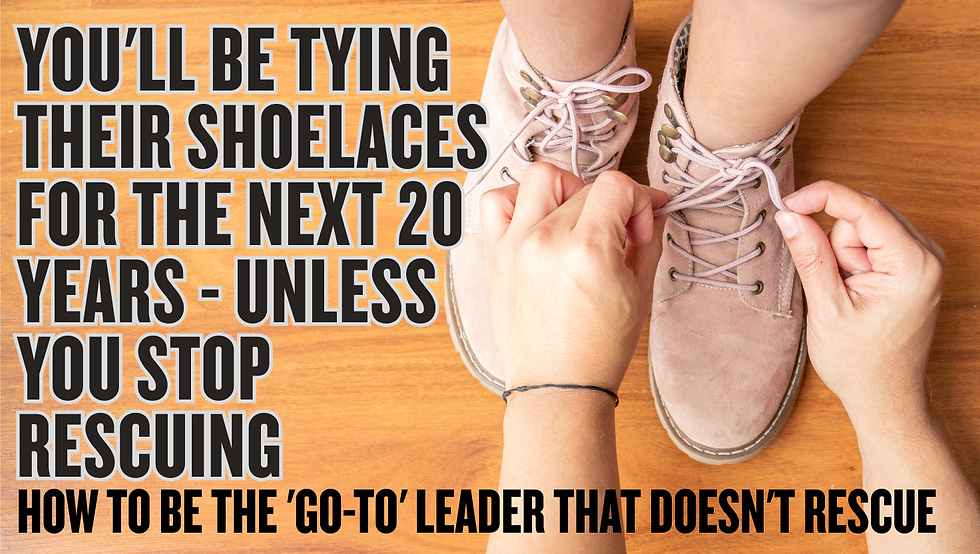
The Shoelace Analogy
Learning to tie shoelaces is one of the most painful parts of parenting, especially if, like me, patience is not your strongest point!
You're trying to get your child out the door. They're fumbling with the laces. You can see exactly what they need to do, and it would be so much faster if you just did it yourself.
It would also mean you'd be tying their shoelaces for the next 20 years. Probably have to go to university with them. Or send them off in Velcro shoes.
Leading your team works the same way.
Jumping in and solving the problem feels helpful in the moment. It's faster. It's easier. You know what you're doing.
What it actually means is that you'll be solving that same problem over and over again, because you've never given them the space to learn how to do it themselves.
A short-term fix that creates a longer-term problem.
A coaching approach takes more time up front. Asking questions instead of giving answers feels slower. However, over time, you reduce the number of times they need to come back to you.
You have to go through that discomfort now so there isn't more pain further down the line.
You have to trust the process.
Why Leaders Need To Stop Rescuing
When you solve problems for your team, you're not just saving time. You're telling them they don't have the answer.
People perform best when three core needs are met: autonomy, competence, and connection. Every time you jump in with the solution, you take away their autonomy. You make them doubt their competence. And you risk disconnecting them from their own capability.

When you give them space to work through the problem themselves, you're building their confidence. Every time you jump in, you're eroding it.
If your team keeps coming to you, it's because they've learned to come to you. You're quick to give answers. You make decisions fast. You solve things efficiently.
They're not seeing you as someone to escalate complex issues to. They're seeing you as someone they can get a quick answer from. And that pattern keeps both of you stuck.
You're Tied to Your Work - You Can't Take The Big Week Off
The Big Week Off is the ultimate test of whether you're leading from the front or trapped at the centre of your team and the work that they do.
Can you take a full week off?
Zero work, zero stress, zero guilt.
No checking in. No logging on. No "just quickly reviewing this." No, 'just in case'
If the answer is no, then in all likelihood one of two things is happening:
1) Your team isn't capable enough yet.
2) You don't trust/believe that your team isn't capable yet.
And that's not their fault.
This is your leadership challenge to resolve.
Success that feels as good as it looks means going home on time and having a team confident enough to operate without you. That doesn't happen by accident. It happens when you stop rescuing and start coaching.
What To Do Instead - The Coaching Approach for Leaders
Ask questions before you solve.
When someone brings you a problem, your first response needs to be: "What are your thoughts?" or "What have you tried already?" or "What options can you see?"
You're not being unhelpful. You're helping them think it through instead of thinking it through for them.
Recognise that delegation is proactively creating development opportunities.
Delegation isn't about getting tasks off your plate. When done well, delegation increases your team's skill set and confidence with guidance and support.
When you delegate well, you're not just freeing up your time. You're building capability within your team. You're developing problem-solvers instead of problem-dumpers.
Recognise and accept that the best problem-solver on your team doesn't need to be you.
One of the clearest signs of a confident leader is someone who says: "I don't know that, but this person on my team is in this all the time. Speak to them."
That shows confidence. Confidence in recognising the skills around you. Confidence in not needing to take everything on yourself.
Your team has expertise. Use it.
Being needed as a leader isn't the same as being a valuable leader
Your value as a leader doesn't come from being the person with all the answers.
Valuable leaders build a team that's capable, confident, and self-sufficient. A team that can operate when you're not in the room. A team that comes to you for strategic directiona and authorisation, not quick fixes.
Effective leaders make 'The Big Week Off' possible.
When leaders are efficient and effective, they focus on their team performance and what needs to happen to create an environment that allows them to perform at their very best.
Great leaders have built a team strong enough that the team doesn't depend on them being constantly available.
Reactive leadership by default becomes intentional leadership by design.
And that's when success starts to feel as good as it looks.
Ready to transform from reactive to intentional leadership?
I help overwhelmed leaders transform from reactive to intentional leadership in 8 weeks, so you finish work on time, take The Big Week Off with zero work and zero guilt, and create success that feels as good as it looks.
The Elevate Your Efficiency Blueprint addresses the root cause - the habits, behaviours and identity keeping you stuck - not just the symptoms. The Leadership Community helps you keep the momentum of progress going.
Free Training: www.zoethompson.uk/quick-links
YouTube Channel: Intentional Leadership with Zoë Thompson
Podcast: The Lightbulb: Weekly Insights for Intentional Leaders


